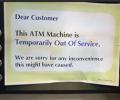
Bengaluru resident Krishnan H tells us about a State Bank of India ATM counter where most of the machines are dysfunctional.

Bangalore resident Ramesha SG tells us how he left his card at the ATM and lost Rs 26,000.
We had asked you, dear readers to share your good and bad ATM experiences.

'Credit card debt comes with high interest cost and stringent penalties.' 'If you do not repay on time, the costs balloon.'

Very often we all have used Automated Teller Machines (ATMs) to withdraw money. But only a few of us think about the repercussions of an attack on a national centralised server which manages the transactions across ATMs.

It's always been a struggle for economists and statisticians to forecast India's gross domestic product (GDP) correctly, and say where the economy is headed before the official numbers come out. If estimating the GDP is tough, forecasting it in real time is complicated. It involves looking at tens of indicators, such as industrial production, electricity consumption and exports, to arrive at a number.

The ATMs will open on Friday and at many places they will open on Thursday, he said.

We may turn our noses up at those who do it but that doesn't mean we haven't done one (or all) of these things at an ATM.

The facility has been branded 'Indicash'. Last month, TCPS secured a licence from the Reserve Bank of India to launch white-label ATM operations, under the central bank's scheme 'B'.
As many as 140 million customers of HDFC Bank and Axis Bank are expected to face interruption in banking services in the weekend due to the former's system upgrade and the transition of Citi India business to the latter. Both the banks have notified their customers about the interruption in services. HDFC Bank - the country's largest private sector lender with 93.2 million customers - had announced that it will undertake a system upgrade on July 13, wherein it will migrate its core banking system (CBS) to a new engineered platform to enhance customer experience.

Prayagraj is transforming into a massive temporary city to host the Maha Kumbh, the world's largest religious gathering, expected to draw over 40 crore pilgrims. The preparations include extensive infrastructure development, including 160,000 tents, 150,000 toilets, and a 1,250-km pipeline network. The event, starting on January 13, will culminate on February 26, bringing together millions of devotees for the holy dip at the confluence of the Ganga, Yamuna, and Saraswati rivers.
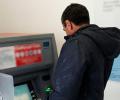
Mumbai resident Sumesh Pillai tells us how he panicked when the ATM didn't dispense cash and what happened later.
Did the transaction fail? Did you receive your money on time?

A reader shares a bad experience he had at an ATM. You can share yours too!

But what do banks gain by opening their apps for all? The answer -- rival bank's customers under their fold.
India Pay, the new payment system, will handle all domestic transactions and work with payment networks like Visa and MasterCard for international transactions undertaken by Indian cardholders or foreigners visiting to the country. Once the processing work shifts to India, transaction costs will come down. At present, the fees charged by Visa and MasterCard are relatively high.
Many customers have had to deal with printouts saying 'transaction declined.' Customers using their own banks' ATMs did not, however, face similar problems. Transactions on a bank's home ATM network are processed through a different switching system, while inter-bank transactions go to NFS, the country's largest domestic network for authentication and routing payment details of various e-commerce transactions and e-government activities.
Union Bank, Andhra Bank, YES Bank launch cash transfer.

The cash transactions have been stopped at the branches belonging to the Jammu and Kashmir Bank and Ellaquai Dehati Bank.

About 70 per cent of ATMs in India are running on outdated operating systems, which makes it easier for fraudsters to crack them
A visit to an ATM today can help you accomplish myriad value-added transaction services like utility payments, pre-paid mobile re-charge, credit card payments, tax payments and much more.
In a massive push for cashless transaction, State Bank of India, the country's largest bank, plans to increase the number of its ATMs by over three times to 25,000 in the next three years.

Here's how Ganesh Pillai got his card back from the ATM machine.

Readers share their good and bad ATM experiences.

An analysis for the first eight months of CY18 shows that the value of RuPay and UPI transactions constitute 65.2 per cent of all transactions done through debit and credit cards, in value terms, across retail outlets by the end of August.

India is an under-penetrated ATM market with only 98 ATMs for every 10 lakh of population.
Mobile wallet adoption is surging in India and swiftly becoming a primary payment option, surpassing traditional methods like cash and cards. Over the next few years, payments via mobile wallets in India are likely to surpass the Rs 531.8 trillion mark in 2028, witnessing a compound annual growth rate (CAGR) of 18.3 per cent between 2024 and 2028, according to GlobalData - a London-based leading data and analytics company. The value of mobile wallet payments in India, as per a GlobalData report, grew at a CAGR of 72.1 per cent between 2019 and 2023 to reach Rs 202.8 trillion ($2.5 trillion) in 2023.
Sweeping reforms mooted; feedback open till Aug 27.

Nandan Nilekani-led task force on an Aadhaar-enabled unified payment infrastructure has recommended setting up a network of one million interoperable micro-ATMs across the country.

Amidst rising demand from banks that they be allowed to increase user fees and limit free ATMs, RBI Deputy Governor K C Chakrabarty said it is "ridiculous" for a bank to charge its own customers for these services.
Banks that own ATMs charge an inter-change fee for providing the facility to the customers of other banks. For larger players such as SBI, ICICI, HDFC and Axis Bank, the shift would mean higher revenues as customers would tend to use the nearest ATM. Smaller banks, which already allow their account holders to access any ATM without having to pay a transaction charge, fear the bigger players, sensing an opportunity, may increase the inter-change fee over the next 6 months.

It is likely he will rope in an international ATM manufacturer as a strategic partner with equity stake.

Rediff reader Shan Anbu, 42, tells us how his card got stuck in the ATM due to lack of backup power facility.
Since payment alternatives such as UPI, e-wallets and USSD - based mobile banking through different platforms are directly or indirectly linked to the user's bank account one needs to be extra careful to keep hackers at bay, explains Adhil Shetty, CEO, BankBazaar.
Union Bank of India, Canara Bank, Andhra Bank, Saraswat Co-operative Bank and YES Bank have come together to allow inter-bank fund transfers through debit cards.

The RuPay card is accepted at all ATMs (1.6 lakh plus), 95 per cent of PoS terminals (9.45 lakh plus) and most of the eCom merchants (about 10,000) in the country.
